
12 Feb Balancing the Board Game – Earth
By Designer Maxime Tardif
Developing Earth has been a lot of fun and a really long process. My main goal while creating Earth was to have a highly strategic and replayable board game with simple rules and minimum limitations. It should play fast, optimize table space as well as card surface area, and have multi-use components and cards. I also wanted Earth to be a Euro game while maintaining a good amount of player interaction; all of that while keeping a low setup and tear-down time.
With all of these guiding factors to consider, my biggest concern was balance. I wanted to create a board game with mechanics that both replicate nature’s diversity and showcase its strengths and complexity. In order to do so, I needed to create a mathematical equation so that all plants, terrain, and events have their place.
With the many variables found on every card and different ways of scoring points involved in Earth, the main challenge was to make sure that all the cards could be used about the same number of times over repeated plays. Keep in mind here that I am no statistician, so I did all this work to the best of my abilities. I am presenting this design information to you for a matter of full transparency, in order to encourage discussions, improve the concept, and give some insights to those who might want to know how to balance their own board game designs. I’d be really happy if this helps somebody!
Just like in real life, different plants are more adaptable to different environments, so in certain games or situations, some plants will perform better than others. But on a macro scale, each card has a valuable place in the ecosystem—some cards will be great starting cards, others better at end game, and some steady throughout. My goal was to develop a board game where, if you play it a lot (let’s say over 1,000 times), all the cards will generate, on average, close to the same number of victory points, so that no plant is always better or worse than another in every situation.
Considering that the game contains 429 unique cards (some cards are double-sided with a different effect on each side), that was quite a puzzle. In order to fit the pieces together, I needed to weigh the strength of all the variables, using probabilities and the play-test statistics we’d been accumulating since the creation of the game (more than 440 unique games). All possibilities needed to be taken into account.
I used the probability that each objective or scoring card comes out every game, and how many points it generates on average per variable it influences1. With that in mind, I was able to calculate how many points every single variable is worth on average on all the cards over numerous games.
Variables in the Game
Base VPs, plant cube slot, growth slot, engine average points generated, ability colors, habitats, geographic term in title, color in title, animal name in title, double ability, 4 VPs or more, 3 VPs or less, 4 soil or more, 3 soil or less, multicolor ability, 4 plants or more, 2 plants or more, 3 plant cube slots or less, 3 or more height, 2 or less growth, even VPs, odd VPs, growth value 5 or more, growth value 4 or less, 6 plant cube slots, 4 or more growth card, brown card, terrain card, 2 habitats or more, 1 habitat or less, plants with plant cube slots or growth slots.
Each of these variables had their own formula created to understand how many points each are worth, on average. After their creation, I spent over three months developing a formula that integrates everything into one algorithm. Once it was done, it allowed me to see how many points each card was actually worth. I could then fix the balance of every single card using this algorithm2. Here’s what the balance looks like in a graph that includes all the plants/terrain cards in the game:
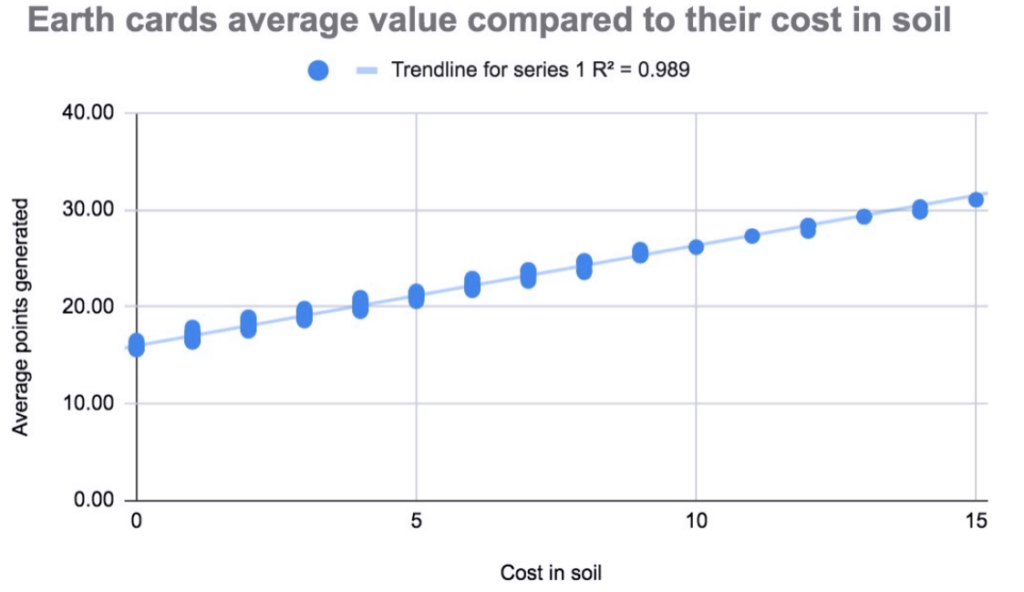
Remember, I am no statistician and it is unlikely the formula and model are perfect, but they do give a good understanding of the balance created in the game. It would be nearly impossible for human play-testers to “feel out” the balance since there are way too many variables and possible interactions. A statistician could surely do better than me and obtain results that are even closer to perfection. (To limit errors while doing this process, I strongly suggest that you put some simple programming in your Excel sheet3.)
I developed such an engine behind the game because I firmly believe that all complex and strategic board games can benefit from such balancing. With all the variables on each card, the more cards you have, the possibilities and interactions become exponential. It is just too much for a human, or even hundreds of humans, to spot them all and balance in a coherent way—devoid of any feelings or emotions.
In addition to balancing the game, the algorithm also gives Earth high replayability potential. Thanks to card strength being situational, every game feels like an exploration where you’re searching for this game’s best combo. A “must-have” card in one game could be first to your “compost pile” in the next. Players shouldn’t feel like they always have to do the same thing in order to win or that they’ve tried all the winning strategies. It also removes the issue of “overpowered” or “broken” cards, making each play enjoyable.
This balancing mixed with the many scoring options and great playtime means you’ve got a board game that you can play hundreds of times without it getting repetitive. My girlfriend and I have played over 220 games and we are still not tired of it (you can see our game record in the Excel sheet).
I sincerely hope that you will enjoy Earth (and its balance) as much as I do. I used all my heart and pushed my skills to their limits to achieve it! So, it is with pride that I present this game to you—I did everything I could to make Earth the best game possible.
Thank you for reading,
Maxime Tardif
p.s. Never in my life have I worked so hard and put so many hours into any project—including when I did my master’s thesis in science! Thanks to my girlfriend Isabelle Touchette, who kindly asked me to create a game about plants, without whom the idea would not have germinated.
Annexes and Examples
1. Take the Japanese maple for example. (Card traits: cost under 3 soil, even victory points, under 3 victory points, rocky and cold habitat, tree, geographic name, 4 cube slots, 4 plant slots or more, 3 growth pieces, 3 growth pieces or more, 4 growth value or less, yellow ability.) The +1 growth and +1 cube of the engine were all taken into account to calculate the average value of the card, then compared to its planting cost to balance it all. It gave an average value of 15.78 for this precise card, with an engine strength of 2.8.

Here’s an example of how to achieve that for every variable on cards. If I take the “under 3 soil” cost in the upper left:
Calculate the score generated by each ecosystem card for under 3 soil: 3 VPs / 2 cards costing 3 soil or less = 1.5 VP per 3 soil or less
Odds of having this ecosystem in the game:
3/64 = 0.046875
Average points generated per game for this condition:
0.046875 * 1.5 VP = 0.0703125
Repeat this process for each Fauna and Terrain card scoring for 3 soil or less. Make an addition of the three results, and you obtain an average value of 0.222575 VPs per game, only for the 3 VPs or less category.
Repeat this process for all other variables and create the formula to calculate the average score of all the cards in the game.
2.

Although this may seem like a complex formula, every variable only points toward an average value of a precise element found on cards. When applied to each card, the sum gives us its average value.
3. To limit the number of errors and back and forth in the Excel sheet, you should use some basic programming so that columns fill themselves automatically as you change variables on cards.
Example: for the 3 soil and under of the Japanese maple above:
=IF(J4<=3,”1″,””)
J4 is the column of my soil values for the cards. What that means is that if the soil value is 3 or less, the box in Excel will fill automatically with a 1. If not (4 or more), the box will be empty. So, if I change the soil value to put it at 4, it will automatically change to 1 in the column, without having to always double-check.
You do that for all variables so that when you change elements on cards, all the variables change automatically and fill by themselves into your formula. Everything needs to be automated to minimize possible errors.
To calculate the percentage of prevalence of all the variables on cards, you use the simple Excel formula, then divide by the number of cards:
=SUMPRODUCT(BA2:BA284)
So, you rapidly know that 125 cards cost 3 soil or less in the game, which accounts for 51% of all playable cards. This information helps the balancing a lot when determining how many points every objective targeting this variable should give.
Sorry, the comment form is closed at this time.